



Lessons From a Working Journalist
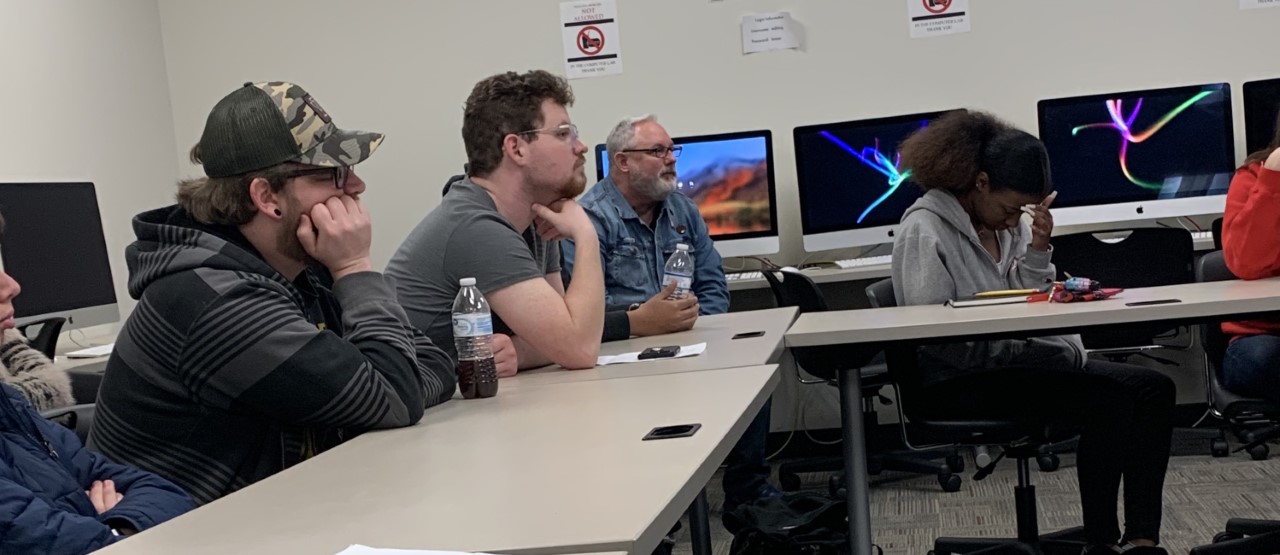
Stefan Malick and his students look on as Cassie Jenkins discusses using social media to crowdsource at Lamar University on Mar. 6
I was the features editor for my high school newspaper a number of years (ahem, a large number of years) ago. When I returned to college after a long break in the fall of 2018, I continued on as a journalism major.
Exactly one University Press article later, I changed my major to corporate communication.
Journalism beyond high school is hard. I respect it, I enjoy consuming it, but I was happy to tuck that part of my writing life in the past and focus on the less-nuanced style of writing that careers in PR require.
Fast-forward to spring of 2020 and I find myself in a feature writing class. Faced with the choice between PR writing and feature writing and I went with the latter, thinking I would be writing lush, whimsical reflections on life and experience.
I was quickly humbled. Not only is journalism a language I can understand but not speak, it is based on a formula you can only learn through trial and error. I thought the class would be a nice series of terms to memorize, chapters to read, tests to take. Instead, it is a sink-or-swim experience in which we are essentially writing for the University Press for the semester.
Now, I love to write. It is my preferred method of self-expression. But I am used to writing for an audience of one, maybe two people. The prospect of having a body of published work at the end of this course is both tantalizing and terrifying because it will theoretically go before all the eyes of Lamar University.
But with each interview, I start to feel that familiar tug of excitement again. The platform an audience provides is exciting, and I am starting to wonder if maybe this style of writing - of communication - is worth deeper consideration.
When Cassie Jenkins of The Port Arthur News came to Lamar to speak to communication majors about the benefits of crowdsourcing your social media for story ideas and source procurement, I was most interested in analyzing how she seemed to feel about being a working journalist post-college.
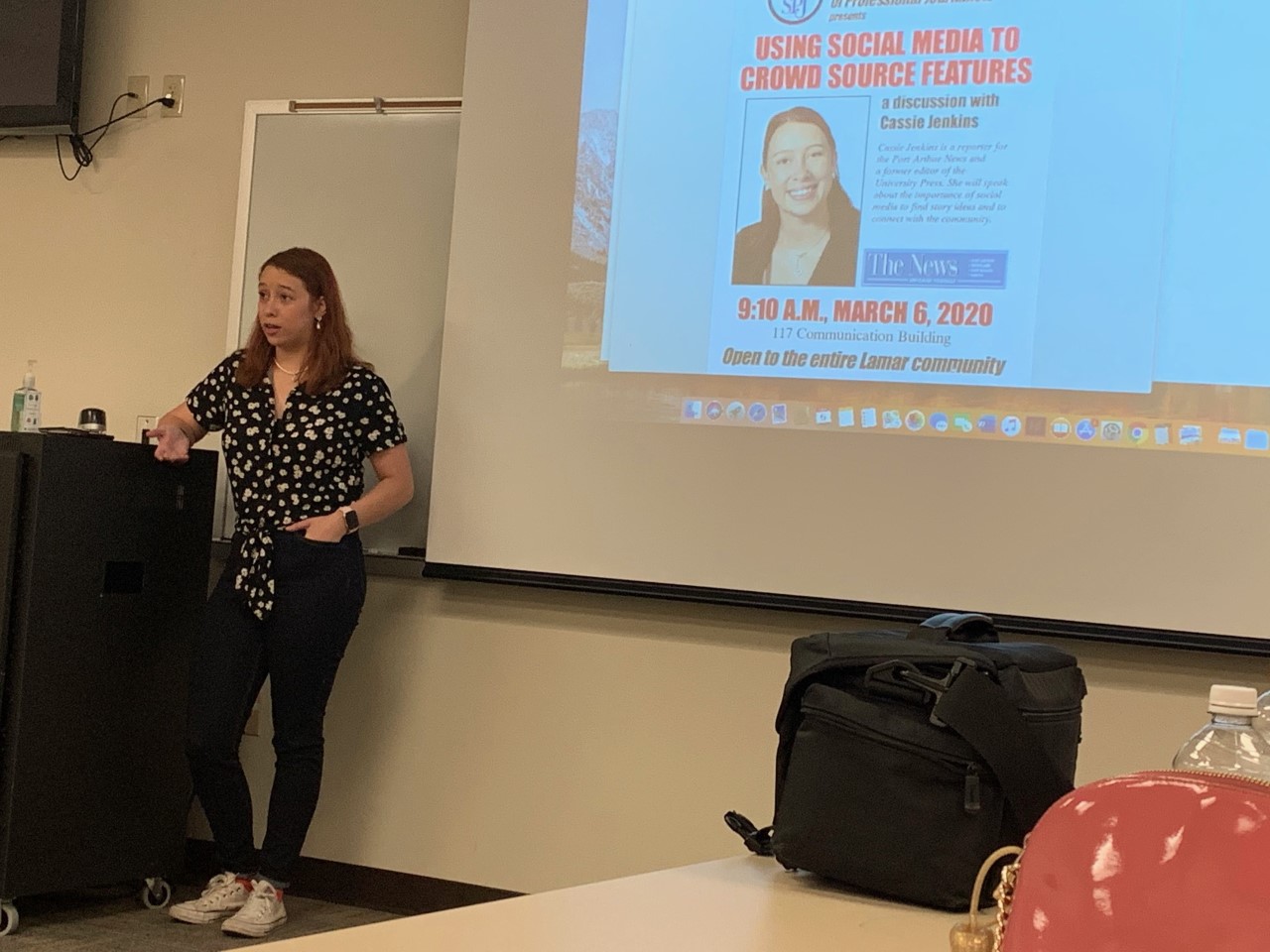
Cassie Jenkins speaks to Lamar students on March 6
The 23-year-old former editor of the University Press has been writing for the Port Arthur news since July of 2019. She works under a daily deadline requiring two news stories. She is also responsible for features and restaurant reviews weekly.
I was not surprised to learn she utilizes Facebook community groups. I have seen reporters from various organizations in my local Bridge City pages and I use the neighborhood groups myself to learn about wrecks, which bugs are going around, flooding/weather-related posts and school-related issues.
Cassie emphasized the importance of developing relationships within the community you are covering and how this can help to maximize your ability to find sources under a deadline in the future. In an area like Southeast Texas where several small towns make up a large interconnected network, the power of connections is not to be underestimated.
She said the hardest part of her job is tracking down sources, essentially moving targets, while under a deadline. But she noted that strategically planning your stories can save a reporter time and energy. For example, she described how, as an education writer, she covered a high school shop teacher who gave a student a car. While she was there, she also interviewed students about their experience in the shop program, buying herself two stories with one trip.
As a busy mother of two boys, I am intimidated by how much driving and strategizing goes into covering a reporter's beat. Cassie's method of maximizing her time resounded with me. I also liked how she encouraged us to try to find a way to write about what we know/love. She mentioned several times that she is an education writer. I am fascinated by health communication. Public health, public safety, and mental health awareness are topics I could cover indefinitely without losing interest.
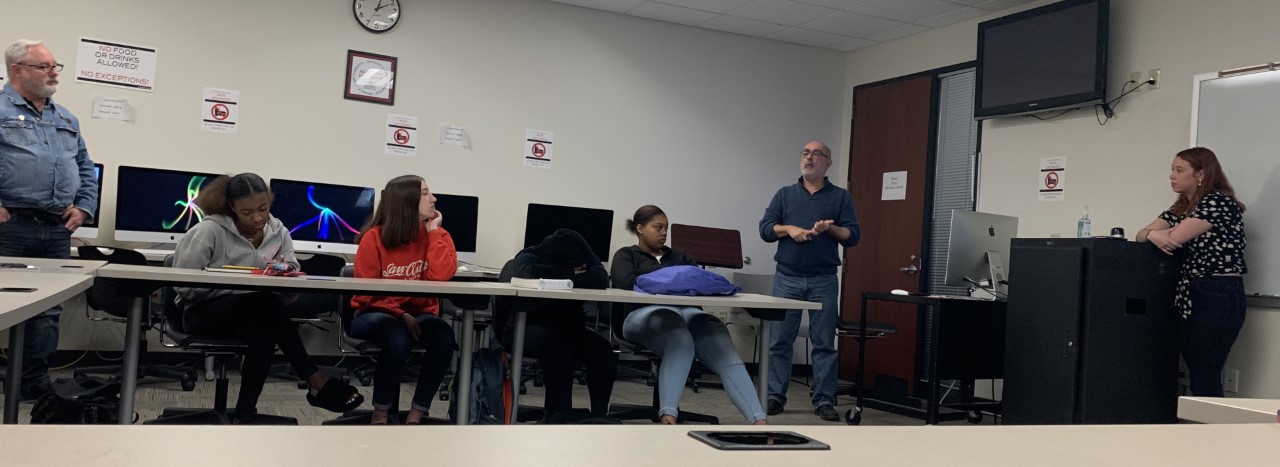
Andy Coughlan leads a Q and A on March 6
Finally, Cassie made an excellent point that I keep overlooking in my own work: share your progress. She described how sharing a teaser boomerang of a popular kid from the community garnered her way more views than normal, and when she published and shared the actual article, those views surpassed the teaser. Having a moderately professional camera is a huge advantage in today's media. We are a visual audience of swipers; punchy headlines and compelling photos are key to standing out.
Cassie's visit was important because it was incredibly motivating to see someone out there making a living off of her writing. Her energy and enthusiasm reminded me of myself when I was that age. As a more cautious student in my 30s, I'm not sure if pursuing a career as a journalist is feasible. But I am certain that I want to learn to write like one.
